
The benefits of AI in construction are no longer science fiction; they’re the concrete reality reshaping job sites from the ground up. I remember visiting a site last year where the project manager pulled out his tablet, not just to check a blueprint, but to show me a live AI model predicting a potential crane path conflict for the following week. It wasn’t just impressive—it was a quiet sigh of relief, the kind that comes from preventing a nightmare before it happens. That moment crystallized it for me: this isn’t just about new tools, it’s about a fundamental shift in how we build our world.
So, how does this shift actually appear in practice? Let’s move beyond the hype and explore the ten most impactful, real-world benefits of AI in construction that are delivering value right now.
1. From Reactive to Predictive: Proactive Risk Management
Remember the last time a sudden equipment failure or a weather delay brought your entire schedule to a grinding halt? That reactive scramble is becoming a thing of the past. The core benefits of AI in construction shine brightest in predictive analytics. By analyzing historical data, weather patterns, sensor data from machinery, and even crew productivity rates, AI can forecast issues with uncanny accuracy.
I spoke with a superintendent in Texas who uses AI-powered site monitoring. The system flagged a pattern of minor vibrations in a piling rig that humans had missed. It predicted a bearing failure within 48 hours. They replaced it during a planned maintenance window, avoiding a catastrophic breakdown that would have cost weeks of delay. This isn’t guesswork; it’s informed foresight.
How Predictive AI Works on Site:
- Equipment Health Monitoring: Sensors feed data to AI, which learns normal operational patterns and flags anomalies.
- Weather and Delay Forecasting: AI links your schedule and hyperlocal weather data to make proactive adjustments.
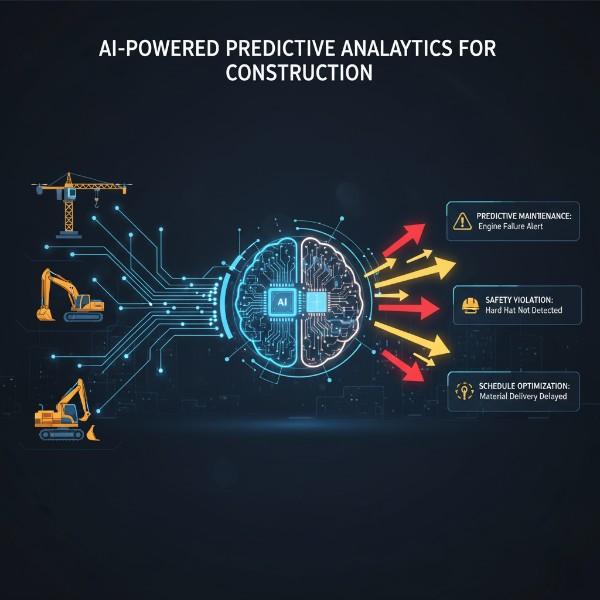
- Site Safety Forecasting: By analyzing video feeds, AI can predict potential safety incidents by recognizing unsafe patterns of behavior or site conditions.
2. The Guardian Angel on Site: Enhanced Safety Monitoring
Safety is the highest priority, yet human monitoring has inherent limitations. AI acts as a 24/7 digital guardian. Cameras equipped with computer vision can constantly scan the site, identifying hazards in real-time—from workers without proper PPE to unauthorized entry into exclusion zones or a potential trench collapse.
A project lead in Seattle shared a sobering story. Their AI site-monitoring system sent an alert for a “fall risk” after it identified a worker approaching an unguarded edge while visually distracted by his phone. The site foreman got the alert on his watch and called out to the worker immediately. It was a silent, constant layer of protection that literally watched their backs.
Implementing AI Safety:
- Start with high-risk areas: crane operation zones, deep excavations, and material handling paths.
- Use AI to automate PPE checks, ensuring everyone entering the site has hard hats, vests, and safety glasses.
- Review AI-generated safety reports weekly to identify recurring risk patterns and improve training.
YouTube Video: Best Guide on Top 10 Benefits of AI in Construction
Watch this helpful video for a visual breakdown of how AI is enhancing safety and efficiency on modern construction sites:
3. The End of Budget Black Holes: Unprecedented Cost Control
Budget overruns are the ghost that haunts every project. AI tackles this by providing granular, real-time financial visibility and forecasting. It analyzes procurement costs, labor hours, equipment usage, and even material waste to identify cost overruns almost as they happen.
A residential developer confessed to me that before using an AI cost-management platform,
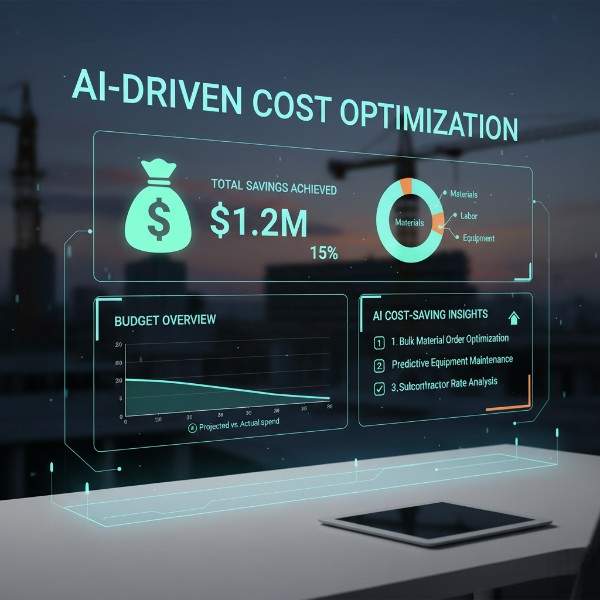
they’d often discover budget issues at the end of a phase. Now, the AI flags if the concrete pour for a foundation block is trending 15% over the estimated volume, allowing for immediate investigation into formwork issues or measurement errors. This level of control is transformative.
4. Designing with Intelligence: Generative Design and Optimization
The benefits of AI in construction begin long before the groundbreaking. Generative design tools use AI to explore thousands of design permutations based on your goals (cost, materials, energy efficiency, spatial requirements). You input parameters, and the AI outputs optimized options a human might never conceive.
An architect friend was designing a complex, curvilinear façade. The AI generative design software balanced structural integrity, material cost, fabrication feasibility, and solar gain, presenting options that reduced steel tonnage by 8% while improving energy performance. It turned a design challenge into an optimized solution.
5. The Perfectly Synced Orchestra: Improved Project Planning & Scheduling
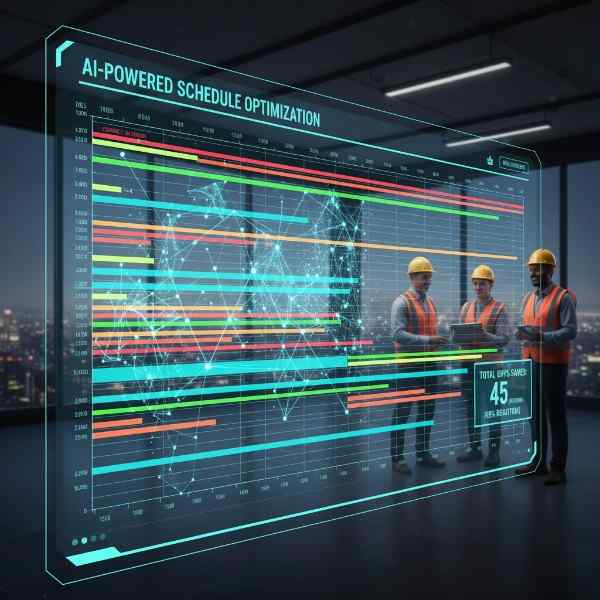
Scheduling is a complex, dynamic puzzle. AI-powered scheduling tools (often integrated with 4D/5D BIM) don’t just create a static Gantt chart; they simulate the entire project thousands of times, accounting for uncertainties. They identify the optimal sequence of tasks, predict the impact of delays, and suggest recovery paths.
On a large hospital project, the AI scheduler recommended resequencing the MEP (Mechanical, Electrical, Plumbing) installation in a specific wing based on delayed custom ductwork delivery. This prevented trades from stacking up and idling, saving thousands in labor costs. The project finished two weeks ahead of the traditional schedule.
Key Steps for AI-Driven Scheduling:
- Feed the AI your historical project data—it learns your company’s actual performance speeds.
- Integrate it with your BIM model for spatial conflict awareness.
- Use it for daily “what-if” scenarios to make agile decisions.
6. The Tireless Inspector: Quality Assurance and Defect Detection
AI doesn’t get tired, distracted, or miss details in poor lighting. Drones and site robots equipped with AI can perform consistent, meticulous quality inspections. They compare scans of installed elements—like welded joints, concrete pours, or brickwork—against the digital BIM model, flagging deviations down to the millimeter.
I honestly wish I had learned about this technology earlier in my career. The time spent on manual, checklist inspections was immense. Now, an AI can scan a completed floor slab for cracks or levelness in a fraction of the time, generating a detailed heat-map report for the quality team to review. This ensures higher quality standards and reduces costly rework.
7. Building Green from the Blueprint: Sustainability and Waste Reduction
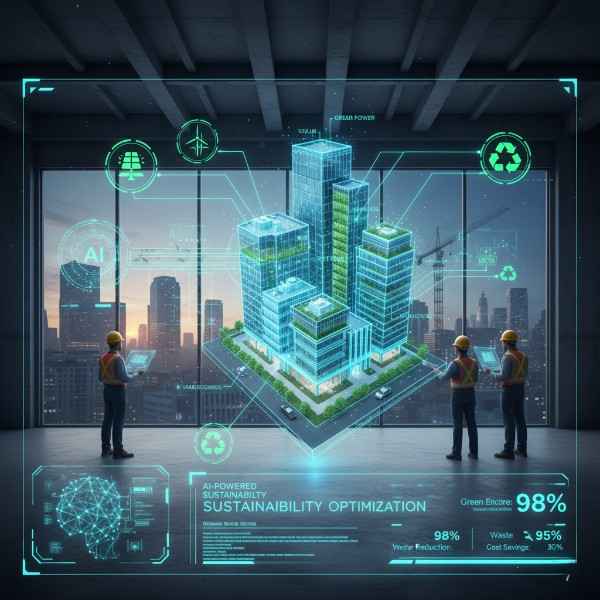
The construction industry is a major resource consumer. AI contributes to greener building by optimizing material usage, reducing energy consumption during construction, and planning for a building’s operational efficiency. It can calculate the exact amount of material needed, minimizing cut-off waste, and suggest alternative, sustainable materials that meet performance specs.
According to experts at Forbes, AI-driven logistics can reduce material transportation emissions by optimizing delivery routes and schedules. Furthermore, AI in Building Management Systems (BMS) post-construction can slash a building’s energy use by up to 20%, making the long-term benefits of AI in construction deeply ecological.
8. The Future is Autonomous: Robotics and Automation
Robots, guided by AI, are taking over dangerous, repetitive, and precise tasks. From autonomous bulldozers performing site grading to bricklaying robots and rebar-tying machines, this increases productivity, addresses labor shortages, and enhances safety by removing humans from hazardous environments.
A recent study by Statista suggests the market for construction robots is set to grow exponentially this decade. On a tunneling project, using an AI-guided robotic drill not only improved precision but also collected geological data in real-time, allowing for dynamic adjustment of support plans—a fantastic dual benefit of AI in construction.
9. Smarter Supply Chains: Logistics and Inventory Management
AI transforms the chaotic construction supply chain into a responsive, just-in-time network. It predicts material needs based on the project phase, monitors inventory levels in the site yard, tracks shipments in real-time, and can even suggest alternative suppliers or materials in case of shortages or delays.
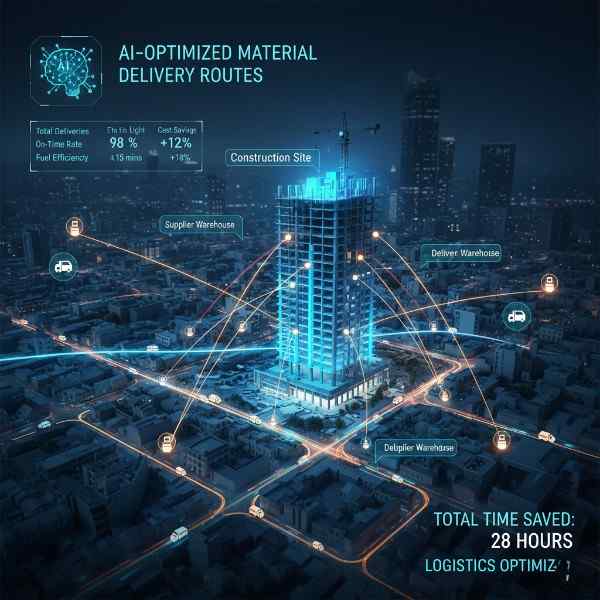
Have you ever had a project stalled waiting for a specific window shipment? AI logistics platforms can anticipate these bottlenecks by analyzing global shipping data and port delays, giving you weeks of advance notice to pivot.
Practical AI Logistics Benefits:
- Reduced on-site material storage (and theft risk).
- Minimized capital tied up in excess inventory.
- Fewer delays due to missing or incorrect materials.
10. The Data-Driven Legacy: Lifelong Building Operations & Maintenance
The benefits of AI in construction extend far beyond the ribbon-cutting. The “digital twin” created during construction—a live AI model fed by IoT sensors—becomes a powerful tool for facility management. It can predict when an HVAC filter needs changing, a pump is likely to fail, or how to optimize space usage.
This creates a valuable data legacy for the building owner, turning the construction process into the first phase of a smart, efficient, and lower-cost operational lifecycle. Check our detailed guide on digital twin technology to see how this future is already here.
Bringing It All Together: A Quick List of AI Impact
To see the holistic change, consider how these benefits of AI in construction interact:
- Pre-Construction: Generative design and AI scheduling set an optimized, low-risk foundation.
- During Construction: Predictive safety, quality drones, autonomous plant, and cost control work in concert.
- Post-Construction: The digital twin enables sustainable, cost-effective building management.
Conclusion: Building a Smarter Future
The journey through these ten areas reveals that the ultimate benefits of AI in construction are about augmentation, not replacement. It’s about giving skilled professionals superpowers: foresight to prevent problems, precision to build better, and data to make smarter decisions every day. This technology is building a future that is safer, more efficient, and more sustainable.
What’s the first challenge on your site—scheduling, safety, or costs—where you think a dose of AI intelligence could make the biggest difference? I’d love to hear your thoughts in the comments below. If you’re ready to explore how these tools can fit into your operations, take a small step today: pick one pain point and research one AI solution that addresses it. The blueprint for the future is waiting to be downloaded.
Frequently Asked Questions (FAQs)
Q1: What are the most immediate benefits of AI in construction for a small firm?
The most immediate advantages are in predictive maintenance, cost control, and safety monitoring. AI tools can forecast equipment failures to avoid downtime, analyze spending in real-time to prevent budget overruns, and provide 24/7 site safety oversight via video analytics. These benefits of AI in construction offer a strong, quick ROI by reducing unexpected costs and risks.
Q2: How is AI used in construction for design?
Through generative design and integration with Building Information Modeling (BIM). AI algorithms can explore thousands of design options based on set parameters (like materials, cost, and energy efficiency) to propose optimized solutions. This process, often called AI construction technology, leads to more innovative, sustainable, and cost-effective building designs before physical work begins.
Q3: Does AI in construction eliminate jobs?
AI is primarily a tool for augmentation, not replacement. It automates dangerous, repetitive, and data-intensive tasks (like defect detection or progress reporting), freeing up skilled workers for more complex, supervisory, and creative problem-solving roles. The key benefit of AI in construction is making human labor safer, more efficient, and more valuable.
Q4: What’s a practical first step to adopting AI on a site?
Start with a specific pain point. For many, the first step is implementing an AI construction software solution for a single task, such as drone-based site surveying and progress tracking, or a predictive analytics tool for equipment maintenance. This focused approach allows teams to learn and see tangible benefits of AI in construction without overwhelming complexity.
Q5: Can AI really help with construction sustainability?
Absolutely. AI enhances sustainability by optimizing material usage to minimize waste, improving energy efficiency in building design and operation, and streamlining logistics to reduce the carbon footprint of transportation. The long-term benefits of AI in construction include creating greener buildings and more environmentally responsible building processes.