
Best Online Courses for AI and Machine Learning are more than just a trendy search term—they’re the gateway to one of the most significant shifts in our lifetime. I remember scrolling through hundreds of options last year, feeling a mix of excitement and sheer paralysis. How do you choose when every platform promises to turn you into an expert? The truth is, the right course doesn’t just teach you theory; it lights a fire under your curiosity and gives you the tools to build something real.
Navigating the Sea of Digital Classrooms: Your First Step
The initial search for the best online courses for AI and Machine Learning can feel like drinking from a firehose. I recall a friend, a brilliant graphic designer, who wanted to pivot into creative AI tools. She signed up for the first highly-technical course she saw, got overwhelmed by week two, and almost gave up entirely. Her mistake wasn’t a lack of ability—it was a mismatch between her starting point and the course’s assumptions. This journey is deeply personal.
A course that’s perfect for a software engineer might be a nightmare for a business analyst. Your mission is to find the syllabus that speaks to your current language and ambitions, transforming complex concepts into actionable knowledge. The landscape of digital education is vast, but finding your ideal learning path is entirely possible with the right guide.
How to Identify Your Ideal Learning Style
- Are you a hands-on builder or a theory-first thinker? Some of the best online courses for AI and Machine Learning throw you into coding immediately, while others spend weeks on foundational statistics.
- Do you need the structure of deadlines or the freedom of self-paced study? Your answer will instantly narrow down platforms.
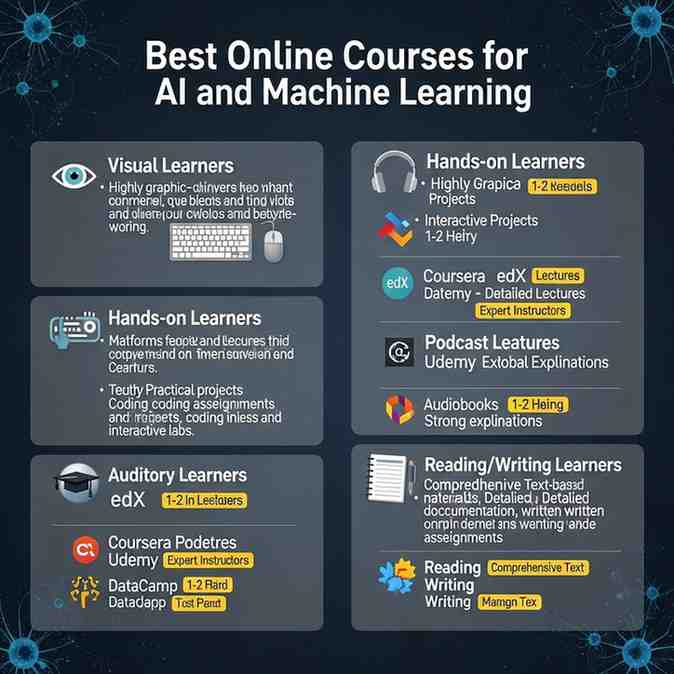
- What’s your “proof of completion”? Is it a shiny certificate for your LinkedIn, a portfolio project, or simply the private satisfaction of understanding a neural network? Your goal dictates your choice.
The Platform Giants: Coursera, edX, and Udacity Deep Dive
When we talk about structured, university-backed education online, two names dominate: Coursera and edX. I’ve taken programs on both, and each has a distinct flavor. Coursera, with its Specializations and Professional Certificates, often feels like a guided tour through a university department. The Machine Learning course by Andrew Ng isn’t just a class; it’s a global rite of passage.
I honestly wish I had learned this earlier: starting with this course would have saved me months of fumbling with poorly explained concepts. edX, meanwhile, often presents the raw classroom experience from MIT, Harvard, and others, which is incredible for academic rigor. Udacity takes a different, project-centric tack with its Nanodegrees. Their “Become an AI Engineer” program is less about lectures and more about building, with mentor support and career services. It’s a premium, career-focused investment.
Comparing the Certification Value
Does a certificate from a best online course for AI and Machine Learning on these platforms matter? From my experience and observing peers, the answer is nuanced. For career changers or those in corporate environments, a certificate from Stanford or DeepLearning.AI on Coursera carries recognizable weight. It signals serious, structured learning.
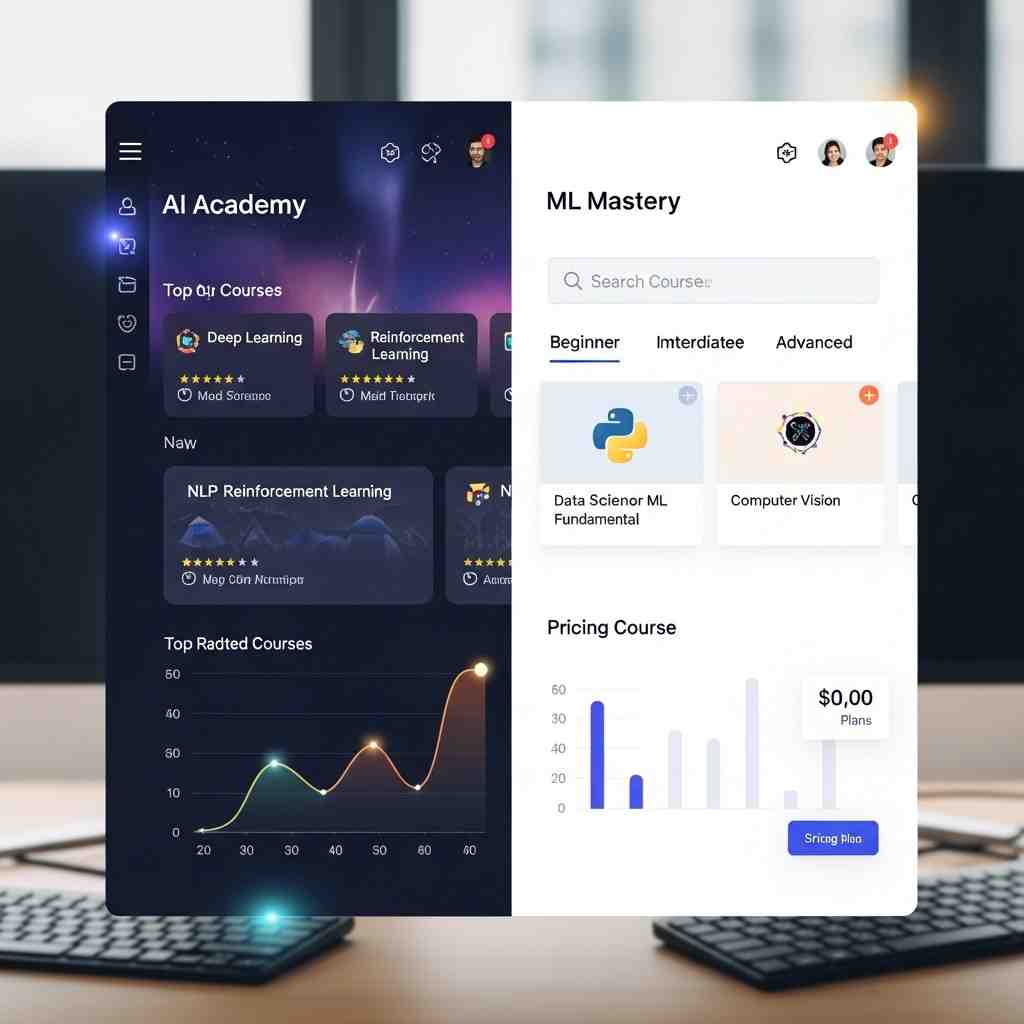
However, in tech and startup circles, your GitHub portfolio of projects from the course often speaks louder than the certificate itself. The key is to use the structure and assignments of these platforms to create tangible proof of your skills.
The Power of Focused, Practical Skill Builders
Beyond the university giants, a new breed of course providers excels at teaching specific, in-demand skills. Platforms like Data Camp, fast.ai, and even certain Udemy courses are where theory meets relentless practice. I spent a month on Data Camp, and their interactive coding-in-the-browser approach for learning Python libraries like Scikit-learn and TensorFlow was a game-changer.
There’s no passive watching; you’re coding every minute. Then there’s fast.ai, built by Jeremy Howard. This is arguably one of the best online courses for AI and Machine Learning if you believe in a top-down, “code first, theory later” approach. It’s challenging, unconventional, and incredibly empowering for those who learn by doing.
Building a Project From Day One
The philosophy behind these practical platforms is simple: the fastest way to understand a random forest algorithm is to build one with messy, real-world data. They often provide curated datasets and incremental challenges that mirror a data scientist’s daily work. This approach builds not just knowledge, but also the problem-solving muscle memory crucial for job interviews and real projects. You finish a course section not just with notes, but with a functioning piece of code you can explain and modify.
YouTube Video: Best Guide on Best Online Courses to Learn AI & Machine Learning
Watch this helpful video: This overview breaks down the pros and cons of major learning platforms, helping you visualize the learning curve and community support each one offers.
Specialized Paths: From Computer Vision to NLP
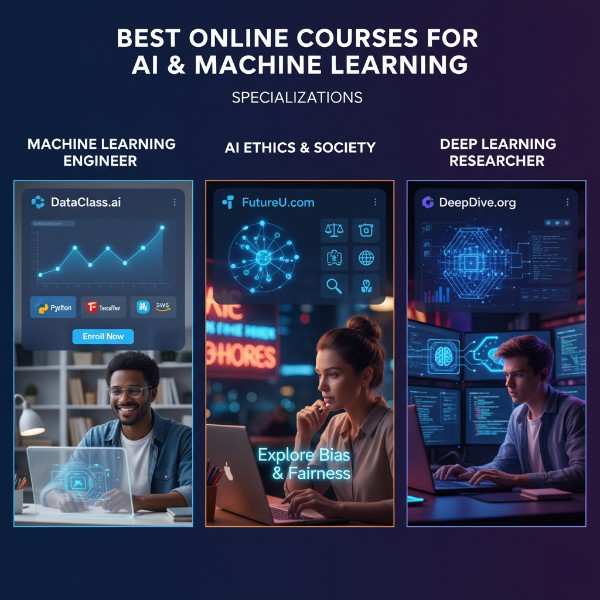
AI isn’t a monolith. Once you grasp the fundamentals, the real magic happens in specialization. Do you want to build systems that understand human language (NLP), recognize images (Computer Vision), or optimize decisions (Reinforcement Learning)? Your search for the best online courses for AI and Machine Learning must get more specific here. For instance, the Deep Learning Specialization on Coursera dives into these areas.
Alternatively, a dedicated course like “Natural Language Processing with Deep Learning” from Stanford online is a deep, academic dive. I gravitated towards computer vision, and working through projects that taught a machine to identify different bird species was the moment it all clicked from abstract to applicable.
Choosing Your AI Subfield
- Natural Language Processing (NLP): Ideal if you’re fascinated by chatbots, translators, or sentiment analysis.
- Computer Vision: Perfect for those interested in medical imaging, autonomous vehicles, or augmented reality.
- Reinforcement Learning: The backbone of advanced robotics, game AI, and complex system control.
The Hidden Curriculum: Community and Mentorship
A factor rarely highlighted in course descriptions is the community. The difference between feeling stuck in isolation and getting unstuck with a helpful nudge is immense. Some of the best online courses for AI and Machine Learning foster incredibly active forums—like the fast.ai forums or the dedicated Slack/Discord channels for many Udacity Nanodegrees and cohort-based courses. I’ve posted a bug at midnight and had a solution from a fellow learner in another time zone by morning. This peer support is a massive, often overlooked, component of the learning value. It simulates a professional environment where collaboration is key.
When to Consider a Cohort-Based Course
For some learners, the ultimate structure is a live, cohort-based course. Platforms like Springboard or Thinkful offer these, blending curriculum with weekly mentor calls and group projects. This model is high-touch, high-cost, and high-accountability. It’s less about finding a best online course for AI and Machine Learning in a catalog and more about joining a program with a defined start and end date,
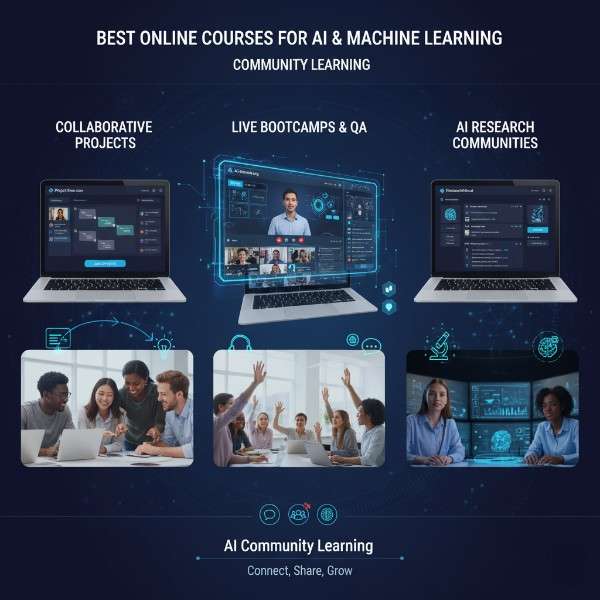
a peer group, and direct access to an industry professional. This is a powerful model for career-changers who need external structure and networking.
Key Factors to Vet Before You Enroll
Don’t just click “enroll” based on a star rating. Here is a practical checklist, born from trial and error, to find your best online courses for AI and Machine Learning:
- Instructor Credibility: Are they an academic titan, a renowned industry researcher (like Andrew Ng or Jeremy Howard), or a practitioner with a proven track record of building things? Listen to a preview lecture
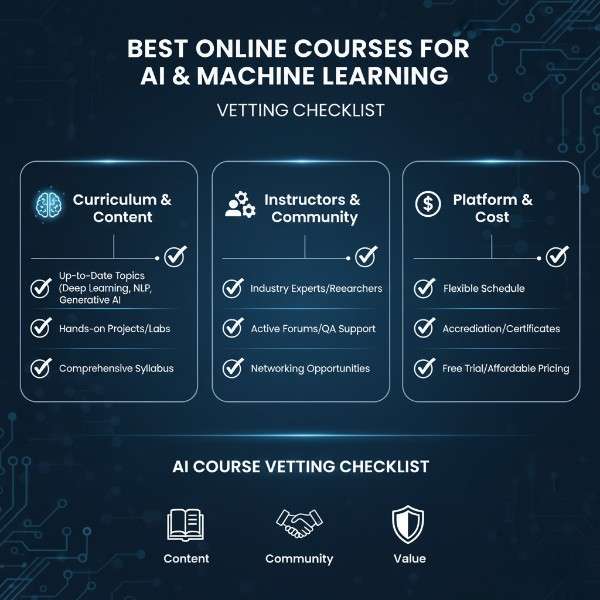
- Project Portfolio: Does the course culminate in a capstone project you’d be proud to show an employer? A best online course for AI and Machine Learning should have a “See what you’ll build” section.
- Toolkit & Languages: Does it use industry-standard tools (TensorFlow/PyTorch, Scikit-learn) and languages (Python/R)? An outdated toolkit is a red flag.
- Prerequisites: Be brutally honest with yourself. Does the course assume calculus, linear algebra, or intermediate Python? Stretching is good; drowning is not.
- Updates: Check the “last updated” date. In a field moving as fast as AI, a course from 2020 might be teaching deprecated methods.
Balancing Cost, Time, and Expected Outcomes
Let’s talk about investment. You can spend anywhere from $15 on a Udemy sale to $20,000+ on an executive education program. The most expensive isn’t automatically the best online course for AI and Machine Learning for you. A common trap is over-investing early on out of excitement. My advice? Start with a modest, high-quality foundational course (like Andrew Ng’s ML or a Python for Data Science course) to confirm your interest and build initial confidence.
Then, invest more significantly in an advanced, specialized program. According to a recent Forbes article on digital education trends, learners who stack credentials starting with shorter courses have higher completion rates for subsequent advanced programs.
Your Next Step: From Learning to Building
The final, most critical phase is transitioning from course-taker to builder. The true test of any best online course for AI and Machine Learning is what you do after the final lecture. Can you take a dataset from Kaggle and apply the techniques on your own? Can you frame a real-world problem from your job or hobby as a machine learning task? This is where learning solidifies into expertise.
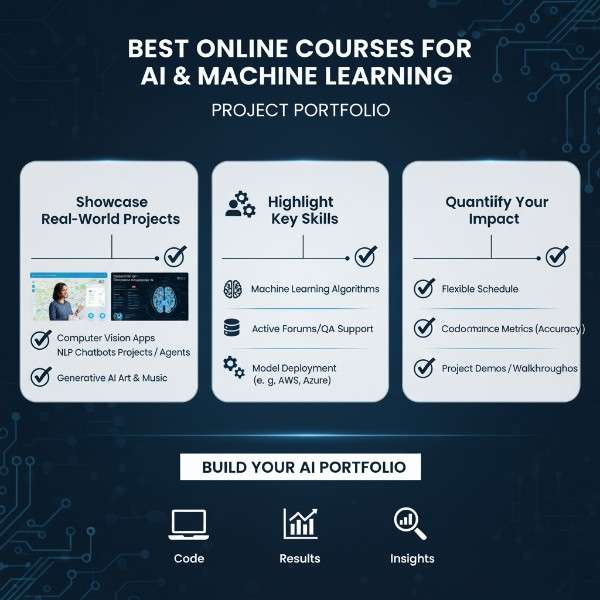
Don’t just collect certificates; collect projects. Start a blog explaining what you’ve built, or contribute to an open-source AI project. This tangible output is what truly validates your learning journey.
Conclusion: Your Journey Starts With a Single Click
Finding the best online courses for AI and Machine Learning is a personal exploration that blends your goals, learning style, and resources. It’s a journey from curiosity to competence, and now, with this roadmap, you’re equipped to start on the right foot. Remember, the perfect course is the one you start and finish. The field of AI is built by learners who turned theory into practice.
Which of these learning paths resonates most with the problem you want to solve? I’d love to hear about your first project idea in the comments below. And if you’re ready to take the next step, check detailed guide on “Building Your First AI Portfolio Project” to turn your course knowledge into a showcase of your new skills. The classroom is waiting.
Frequently Asked Questions (FAQs)
Q1: How do I choose the best online courses for AI and Machine Learning as a complete beginner?
Start by looking for courses specifically labeled “beginner” or “foundations.” The best online courses for AI and Machine Learning for newcomers focus on intuitive concepts before complex math, use accessible programming languages (usually Python), and offer strong community support. Andrew Ng’s “Machine Learning Specialization” on Coursera is often heralded as the perfect starting point.
Q2: Are there any reputable free options among the best online courses for AI and Machine Learning?
Yes, many top platforms offer free audit options. You can access lecture videos and assignments for courses like Stanford’s “Machine Learning” on Coursera or MIT’s “Intro to Deep Learning” on edX for free. However, accessing graded assignments or a certificate typically requires payment. This is a great way to sample a best online course for AI and Machine Learning before committing financially.
Q3: What prerequisites do I need for most of the best online courses for AI and Machine Learning?
A solid grasp of high-school level mathematics (especially linear algebra and calculus) and basic programming proficiency (usually in Python) are the most common prerequisites. Many introductory courses include refreshers, but coming prepared will help you focus on the core AI/ML concepts.
Q4: Can I get a job after completing one of the best online courses for AI and Machine Learning?
Completing a single course is rarely enough. Employers look for a demonstrated skill set. The best online courses for AI and Machine Learning will provide you with the knowledge to build a portfolio of projects, which is your key credential. Success typically involves combining multiple courses or a specialization, then applying that knowledge to original work.
Q5: How long does it typically take to complete a comprehensive program?
This varies widely. A single short course might take 4-6 weeks part-time. A comprehensive Specialization or Professional Certificate (a sequence of courses) can take 3-6 months. More intensive, bootcamp-style programs designed as some of the best online courses for AI and Machine Learning for career changers may require 6-10 months of full-time commitment.