
Fix poor posture naturally. It’s a thought that hits you in a quiet moment of self-awareness—maybe as you catch your slouched reflection in a window, or when that familiar ache between your shoulder blades flares up during a long afternoon at your desk. You’re not looking for a miracle cure or a complex medical procedure; you’re searching for a way back to your body’s natural, effortless alignment.
If you’re tired of the nagging pain and the slumped silhouette, and you want to feel tall, open, and comfortable in your own skin again, you’re in the right place. This is a journey I’ve walked myself, and it’s entirely possible to fix poor posture naturally and for good.
The Day I Realized My Posture Was Stealing My Joy
I remember the moment vividly. I was at a friend’s wedding, scrolling through the photos later, and there I was—in almost every picture—with my head jutted forward, shoulders rounded, looking like I was carrying an invisible weight. It wasn’t just an aesthetic shock; it was a physical one. My neck was stiff, my breathing felt shallow, and I had accepted low-grade back pain as a normal part of being an adult.
That was the catalyst. I decided to learn how to fix poor posture naturally, not with a rigid brace I’d become dependent on, but by understanding and retraining my body. The process wasn’t about perfection; it was about gradual, conscious return to how my body was designed to move.
Why “Natural” Correction Beats a Quick Fix
We live in a world of instant solutions, but your posture didn’t deteriorate overnight. It happened through thousands of hours spent scrolling, hunching over laptops, and adapting to stressful days by literally closing in on ourselves. A quick-fix posture corrector might pull your shoulders back, but it does nothing to strengthen the weak muscles that let them slump in the first place or release the tight ones that pull them forward.
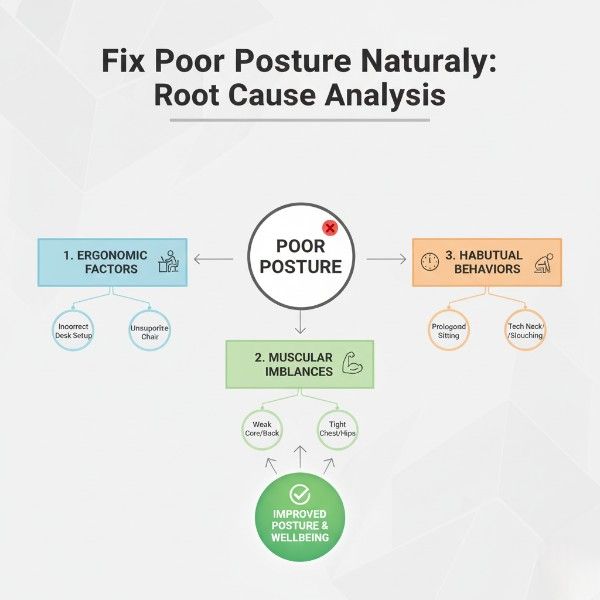
To truly fix poor posture naturally, you must address the root causes: muscular imbalances, habit, and body awareness. This approach builds lasting strength and creates new, healthy defaults that serve you all day, even when you’re not thinking about it.
Your Personal Posture Audit: Awareness Before Action
Before diving into exercises, you need a honest baseline. Stand sideways in front of a full-length mirror in your relaxed, typical stance. Where is your ear in relation to your shoulder? Is it pushed forward? Do your shoulders roll inward? Does your lower back have an excessive arch, or does your pelvis tilt forward? This isn’t about judgment; it’s about information. This awareness is the first and most crucial step to fix poor posture naturally. You can’t change what you don’t see. Try this for a week: set a gentle phone alarm every hour. When it chimes, simply notice your posture. Are you slumped? Reset. This builds the mindfulness muscle.
The Forgotten Art of Breathing for Posture
You might wonder what breathing has to do with posture. Everything. Shallow, chest-based breathing—common when we’re stressed or slouched—reinforces poor posture by keeping the muscles of the neck and chest tight. Deep, diaphragmatic breathing is a natural tool to fix poor posture. It activates your core, promotes relaxation in overworked neck muscles, and encourages a neutral spine.

Try this now: sit or stand tall, place a hand on your belly, and inhale slowly through your nose, letting your belly expand like a balloon. Exhale fully. Feel how your spine naturally lengthens? Practice this for 2 minutes, 3 times a day. It’s a reset button for your entire system.
Foundational Movements: Rebuilding Your Body’s Blueprint
Think of these not as a grueling workout, but as movement medicine. They target the key players: weak back muscles, tight chest muscles, and a disengaged core. Consistency with these is how you fix poor posture naturally and sustainably.
1. The Doorway Stretch: Opening Your Front Line
Your pecs are likely shortened from all that forward hunching. This stretch is instant relief.
- Stand in a doorway.
- Place your forearms on the door frame with elbows at 90-degree angles, forming a “goalpost” shape.
- Step one foot forward, gently leaning into the doorway until you feel a stretch across your chest and shoulders.
- Hold for 30 seconds, breathe deeply. Repeat 3 times.
2. Chin Tucks: Reversing “Text Neck”
This tiny movement is powerful for retraining your head’s position. It’s one of the most effective ways to fix poor posture naturally at the cervical spine.
- Sit or stand tall. Looking straight ahead, gently draw your head backward, as if making a double chin.
- Keep your gaze level—don’t look down. You should feel a stretch at the base of your skull and a lengthening in the back of your neck.
- Hold for 5 seconds, release. Aim for 10-15 repetitions, several times daily.
3. The “Y-W-I” Sequence: Activating Your Upper Back
This bodyweight series wakes up the rhomboids and lower trapezius—the muscles that pull your shoulders back and down.
- Lie face down on a mat, arms extended overhead in a “Y” shape, thumbs up.
- Squeeze your shoulder blades together and lift your arms a few inches off the ground. Hold for 3 seconds, lower. Do 10 reps.
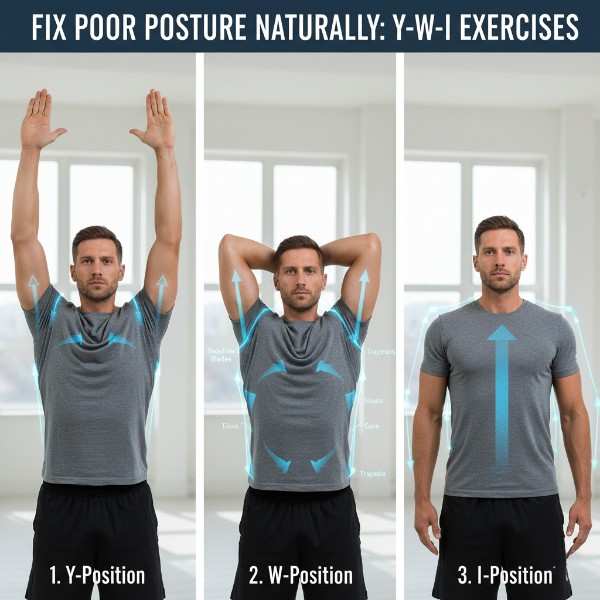
- Move arms to a “W” shape (elbows bent, hands by head), repeat the lift. Do 10 reps.
- Finally, move arms to an “I” shape (by your sides, palms down), and repeat. Do 10 reps.
YouTube Video: Best Guide on How to Fix Poor Posture Naturally
This video provides an excellent visual guide to the foundational stretches and exercises, ensuring you’re performing them with proper form for maximum benefit.
Transforming Your Daily Environments
You can do all the exercises in the world, but if you spend 8 hours a day in a posture-hostile environment, progress will be slow. Let’s fix poor posture naturally by setting up your life for success.
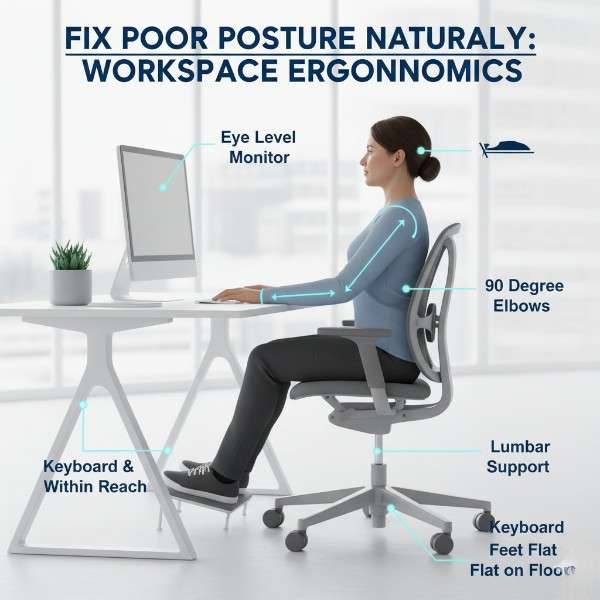
Your Workspace: An Ergonomic Oasis
Your desk setup is ground zero. According to experts at Ergonomics Research Institute – Wikipedia, proper setup can drastically reduce musculoskeletal strain.
- Screen Height: The top of your monitor should be at or slightly below eye level.
- Chair Depth: Sit back so your back is supported. Feet should be flat on the floor.
- Keyboard/Mouse: Keep them close so you aren’t reaching, allowing elbows to stay near a 90-degree angle.
The “Movement Snack” Habit
Sitting is the new smoking for your posture. Set a timer for every 30 minutes. When it goes off, take a 1-2 minute “movement snack.” Stand up, do 5 shoulder rolls, reach for the ceiling, or take a quick walk to get water. This constant micro-resetting prevents your body from solidifying into a slumped position. It’s a simple, non-negotiable habit to fix poor posture naturally throughout your workday.
Lifestyle Tweaks for Lasting Posture Health
Posture isn’t just about your desk; it’s about your entire life. Small shifts in daily activities compound into massive change.
Mindful Phone Use
“Text neck” puts immense strain on your cervical spine. Make a conscious effort to raise your phone to eye level instead of dropping your head. This single change can alleviate neck pressure significantly. When you’re reading or browsing, ask yourself: Can I feel tension building in my neck right now? That awareness is the first step to release it.
Sleeping for Spinal Support
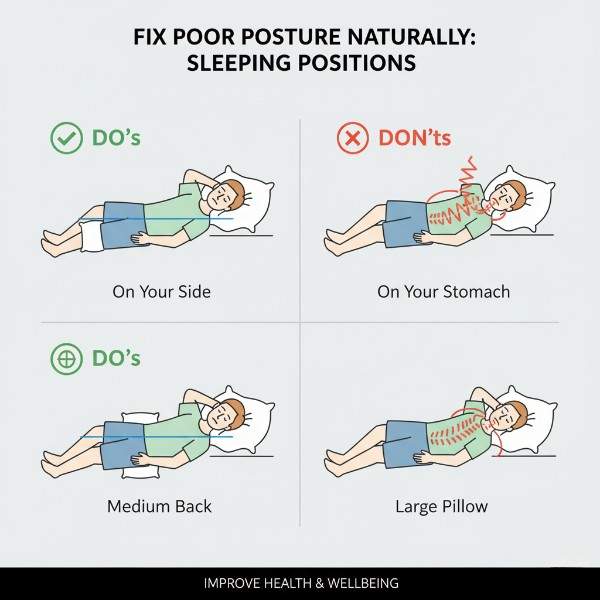
You spend a third of your life asleep—make it count for your posture. The best position is on your back or side. Avoid stomach sleeping, which twists your neck and flattens your spine’s natural curve. If you’re a side sleeper, put a pillow between your knees to keep your hips aligned. This support helps your spine decompress and reset overnight, making it easier to fix poor posture naturally.
The Power of a Simple Walking Practice
Walking is full-body posture training. Focus on walking tall: imagine a string pulling the crown of your head towards the sky, engage your core lightly, let your shoulders relax down and back, and let your arms swing naturally. A daily 20-minute mindful walk reinforces the aligned, strong posture you’re building elsewhere. I honestly wish I had learned earlier that the solution wasn’t always in more exercises, but sometimes in simply moving with intention through my day.
A Simple Daily Routine to Fix Poor Posture Naturally
Consistency beats intensity. Here’s a manageable 10-minute daily plan. The key is to do it almost every day.
- Morning (2 mins): Stand tall and practice 5 deep diaphragmatic breaths. Do 10 chin tucks.
- Mid-Day Break (5 mins): Perform the Doorway Stretch (3×30 sec). Do one set of the Y-W-I sequence (10 reps each).
- Evening (3 mins): Before bed, do a child’s pose stretch for 1 minute to relax your back. Finish with 5 more deep breaths.
This routine strategically uses the focus keyword fix poor posture naturally by integrating the concept into a practical, repeatable list.
When to Seek Professional Guidance
While this guide provides powerful tools, sometimes you need a guide. If your pain is severe, sharp, or includes numbness/tingling, see a doctor or physical therapist. They can provide a personalized assessment. You may also find it helpful to check detailed guide on about choosing a physical therapist for finding the right professional.

For high-quality, non-invasive products, a recent study suggests that the best posture corrector for everyday use is one that acts as a tactile reminder rather than a rigid constraint, helping you build awareness.
Conclusion: Your Journey to an Aligned Life
Learning how to fix poor posture naturally is more than a physical undertaking; it’s a form of self-respect. It’s the decision to no longer accept discomfort as a default setting. This journey asks for patience and kindness—toward the body that has adapted to survive your busy life, and toward yourself as you learn new patterns.

Celebrate the small wins: the moment you notice you’re slouching and correct it, the day that old ache doesn’t appear, the feeling of breathing more fully. Each is a victory.
You now have the map: build awareness, integrate strengthening and stretching, tweak your environments, and be consistent. The path to fix poor posture naturally is laid out in front of you. It’s not about achieving a statue-like pose, but about finding fluid, supported, and pain-free movement. What will your first step be today? Start with one deep breath, and one intentional stretch. Your future, more comfortable self will thank you.
FAQs: How to Fix Poor Posture Naturally
- How long does it take to fix poor posture naturally?
There’s no universal timeline, as it depends on the severity of your posture and your consistency. Most people notice improvements in comfort and awareness within 2-4 weeks. Building lasting muscular strength and new habits typically takes 3-6 months of dedicated practice. The key is to view it as a lifelong practice of body awareness, not a quick fix. - Are posture correctors a good way to fix poor posture?
Posture correctors (braces or straps) should be used cautiously. They can serve as a helpful tactile reminderto sit or stand tall in the short term, but they do not strengthen your muscles. Relying on them can even lead to muscle weakening. The most sustainable method is to use them sparingly while actively performing exercises to fix poor posture naturallythrough strength and habit change. - What is the single best exercise to fix poor posture?
While no single exercise is a magic bullet, Chin Tucksare arguably the most foundational. They directly counteract “text neck” by retraining your head’s position over your spine, which is the cornerstone for all other posture corrections. Pair them with the Doorway Stretchfor the best results. - Can I fix poor posture naturally while I sleep?
Absolutely. Your sleep position can either help or hinder your progress. Sleeping on your back is best for spinal alignment. If you sleep on your side, use a pillow between your knees to keep your hips neutral. Avoid stomach sleeping, as it forces your neck and spine into awkward rotation. A supportive mattress and pillow are crucial investments. - I have a desk job. What’s the most important tip?
The #1 tip is movement breaks. Set a timer for every 30 minutes. When it goes off, stand, stretch, walk for a minute, or simply reset your sitting posture. Prolonged static sitting is the enemy of good posture. Pair this with an ergonomic setup (monitor at eye level, feet flat) to create a posture-friendly environment. For a detailed plan, explore our guide on [online physiotherapy for posture] principles you can apply yourself.